
As search engines evolve faster than ever, businesses can no longer rely on outdated optimization tactics. Understanding the latest trends in SEO is now critical for brands that want to stay visible, competitive, and trusted in the Indian digital market.
This urgency is reflected in the numbers. The SEO software market in India is projected to reach US$ 8.1 billion by 2030, growing at a strong CAGR of 18.2% between 2025 and 2030. This rapid growth highlights how seriously Indian businesses are investing in search visibility as digital competition intensifies.
Search in 2026 is being reshaped by AI-powered algorithms, generative search experiences, voice and regional language queries, and a stronger focus on user intent over keywords. For Indian businesses—whether startups, SMEs, or enterprises—SEO is no longer just about rankings; it’s about relevance, credibility, and consistent discovery across devices and platforms.
The Changing Landscape of SEO in 2026
SEO has evolved well beyond the era of keyword stuffing and low-value link building. With continuous Google algorithm updates—ranging from Panda and Penguin to Hummingbird and advanced AI-driven systems—search engines have become far more intelligent in how they assess content. Today’s algorithms prioritize pages that deliver genuine value while actively filtering out manipulative practices.
This evolution reflects the latest trends in SEO, where relevance, high-quality content, and seamless user experience are no longer optional but essential. As we move into 2026, effective SEO strategies must balance authoritative content, strong technical foundations, and optimized usability. Businesses that align with these trends in SEO are better positioned to earn visibility, trust, and sustainable search performance in an increasingly competitive digital landscape.
This blog on key SEO trends 2026 explains how search behavior is changing and how brands can adapt for sustainable, long-term growth.
Let’s begin…..
Top 7 SEO Trends for 2026
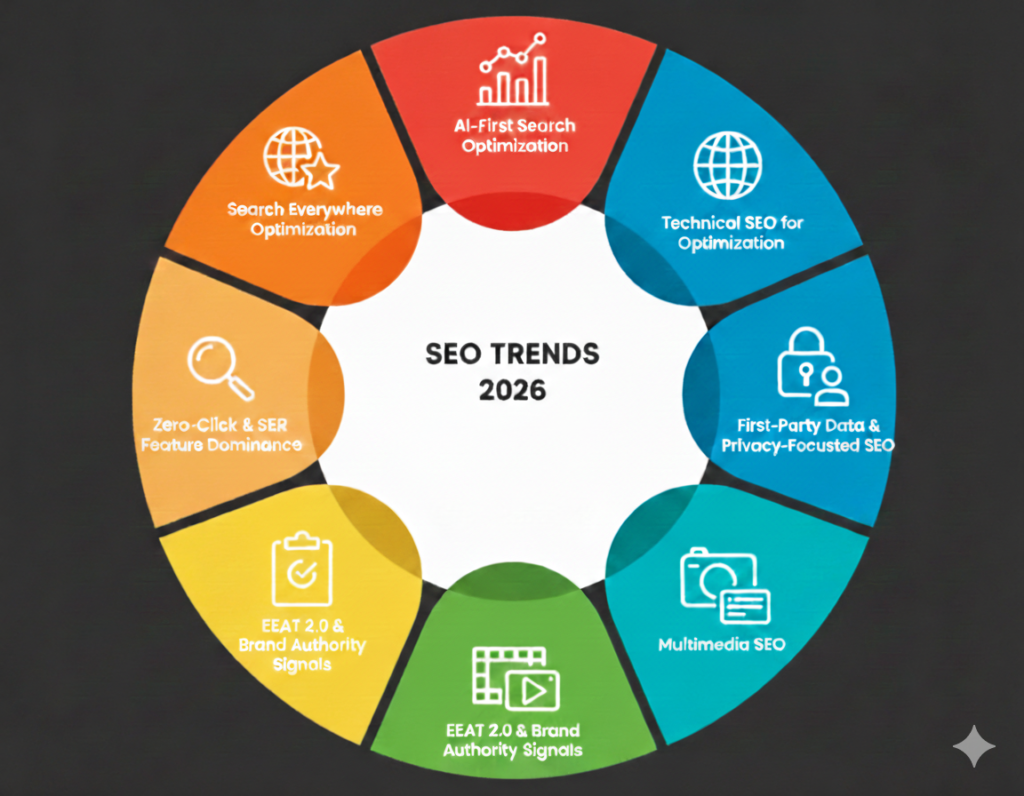
1. AI-First Search Optimization (Generative & Conversational Search)
As part of the SEO trends 2026, search engines now prioritize AI-generated answers, conversational queries, and advanced intent prediction. SEO efforts focus on optimizing content for AI models, featured summaries, and contextual relevance rather than traditional rankings. Brands must structure content so it’s easily understood, trusted, and surfaced within generative search experiences.
Key Pointers
- Optimize content for AI summaries using structured data, clear context, and entity-based relevance.
- Focus on conversational keywords and natural language queries aligned with user intent.
- Create authoritative, answer-focused content that AI systems confidently trust and reference.
2. Search Everywhere Optimization (Google, Bing, ChatGPT, Perplexity)
SEO expands beyond traditional search engines into AI platforms, voice assistants, and discovery tools. Users search everywhere, not just Google. Brands must optimize for visibility across AI chat interfaces, alternative search engines, and content-driven discovery ecosystems to remain competitive in 2026.
Key Pointers
- Optimize content for multiple platforms including AI tools, app search, and voice-based assistants.
- Strengthen brand mentions, citations, and digital footprints beyond owned websites.
- Ensure consistent, authoritative information across search engines and AI knowledge sources.
3. Zero-Click & SERP Feature Dominance
Zero-click searches dominate 2026, with users getting answers directly on SERPs. SEO success now means owning featured snippets, AI overviews, knowledge panels, and rich results. Visibility matters more than clicks, requiring brands to design content specifically for enhanced SERP placements.
Key Pointers
- Structure content to win featured snippets, FAQs, and AI-generated result placements.
- Optimize headings, lists, and schema markup for instant SERP visibility.
- Focus on brand recall and authority, even when users don’t click through.
4. EEAT 2.0 & Brand Authority Signals
EEAT evolves into a brand-level trust system in 2026. Search engines evaluate expertise, experience, authority, and trustworthiness across authors, companies, and digital footprints. Strong branding, expert contributors, and real-world credibility now directly impact rankings and AI citations.
Key Pointers
- Showcase real experts, author bios, credentials, and verified experience clearly on content.
- Build authority through mentions, backlinks, PR coverage, and trusted industry references.
- Strengthen brand trust signals like reviews, case studies, and transparent business information.
5. Multimedia SEO (Video, Audio & Visual Search)
Search in 2026 is visual, voice-driven, and multimedia-heavy. Videos, podcasts, images, and visual search results outperform text-only pages. SEO strategies must optimize multimedia assets for discoverability across platforms like YouTube, Google Lens, and AI visual search tools.
Key Pointers
- Optimize videos with transcripts, metadata, chapters, and schema for enhanced discoverability.
- Leverage image SEO and visual search optimization for product and service visibility.
- Repurpose content into audio and video formats to capture multi-channel search demand.
6. First-Party Data & Privacy-Focused SEO
With cookies fading and privacy regulations tightening, first-party data becomes critical for SEO. In 2026, brands rely on owned data, audience insights, and consent-based tracking to personalize content, improve engagement, and maintain search performance without violating user privacy.
Key Pointers
- Collect user data ethically through subscriptions, forms, and direct audience interactions.
- Use first-party insights to personalize content and improve search relevance.
- Align SEO strategies with privacy laws while reducing dependence on third-party tracking.
7. Technical SEO for Performance, Core Web Vitals & AI Crawlers
Technical SEO remains foundational as AI crawlers become more advanced. In 2026, performance, crawl efficiency, structured data, and site architecture directly influence rankings and AI visibility. Fast, accessible, and machine-readable websites outperform competitors consistently.
Key Pointers
- Optimize Core Web Vitals for speed, interactivity, and visual stability across devices.
- Ensure clean site architecture for efficient crawling by AI and search bots.
- Implement advanced schema markup to help AI systems understand and rank content better.
Conclusion
As we move deeper into a digitally competitive era, trends in seo clearly signal one thing: search is no longer static, keyword-driven, or limited to Google alone. From AI-first search optimization and zero-click SERPs to EEAT 2.0, multimedia SEO, and privacy-focused strategies, these evolving SEO trends redefine how brands achieve visibility and trust. Businesses that adapt early to these trends in SEO will not only safeguard their rankings but also build long-term relevance across AI platforms, voice search, and emerging discovery channels. Ignoring these changes means risking reduced visibility, lost traffic, and declining brand authority.
On the other hand, aligning your digital strategy with key SEO trends 2026 ensures sustainable growth, stronger audience engagement, and competitive dominance in the Indian market. The future of SEO belongs to brands that prioritize intent, experience, performance, and credibility—consistently and strategically.
Ready to future-proof your growth? Get in touch with a top SEO services Mohali company to leverage the latest SEO trends 2026 and stay ahead of the competition.